GeotchaA geography quiz on a real globe
10 most populous regions of Finland
10 regions, each one drawn on a satellite globe. Name it when it lights up, find it when you are given its name, tell its flag from three others, or type every one you can remember in Name all.
Free to start: a few quizzes a day cost nothing, and Geotcha Plus opens every quiz. What you miss comes back for review until it sticks.
The full list
About this quiz
Uusimaa is the largest of the 10 regions in this quiz, at 1.8 M; Ostrobothnia is the smallest listed, at 180 k. Uusimaa's population is 3.3 times Pirkanmaa's (549 k). The three largest hold 62% of the combined population of all 10.
What they are known for
- Uusimaa: Helsinki, the Suomenlinna sea fortress and the old wooden town of Porvoo.
- Pirkanmaa: Tampere grew around the Tammerkoski rapids, with red-brick mills and public saunas.
- Finland Proper: Turku castle and cathedral stand at the gateway to a maze of Baltic islands.
- Northern Ostrobothnia: Oulu sits by the Gulf of Bothnia; Kuusamo offers the rapids and forests of Oulanka.
- Central Finland: Jyväskylä showcases Alvar Aalto architecture among lakes and forests.
- Northern Savonia: Kuopio, the Puijo observation tower and kalakukko fish pies beside Lake Kallavesi.
- Satakunta: Pori hosts a jazz festival; Rauma has a UNESCO-listed wooden old town.
- Päijänne Tavastia: Lahti is known for ski jumps; Lake Vesijärvi links its harbour to inland waterways.
The regions
- 1Uusimaa1.8 M
- 2Pirkanmaa549 k
- 3Finland Proper498 k
- 4Northern Ostrobothnia418 k
- 5Central Finland274 k
- 6Northern Savonia249 k
- 7Satakunta210 k
- 8Päijänne Tavastia205 k
- 9Southern Ostrobothnia189 k
- 10Ostrobothnia180 k
On the map
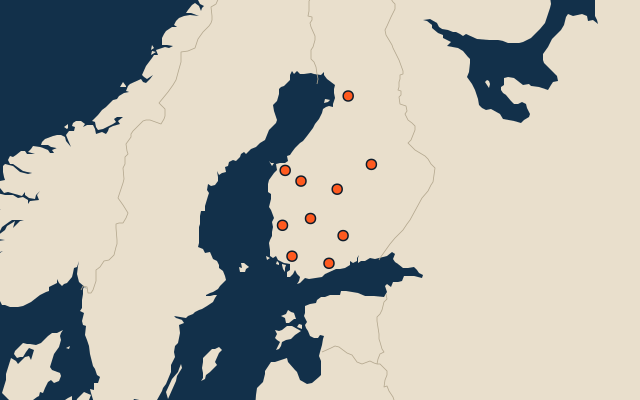
All of Europe
More in Finland
- 25 largest cities in Finland
- Regions of Finland
- 25 largest lakes in Finland
- 21 longest rivers in Finland
- 25 largest islands in Finland
- 7 best known World Heritage Sites in Finland
- Flags of the regions of Finland
- 10 largest cities in Finland
- Cities ranked 26–50 in Finland
- Regional capitals of Finland
Other countries of Europe
- States of Germany
- 10 most populous states of Germany
- Districts of Germany
- 25 most populous districts of Germany
- Regions of Italy
- 10 most populous regions of Italy
- Provinces of Italy
- 25 most populous provinces of Italy
How the figures are measured
Population of each region: the latest figure recorded on Wikidata (P1082), checked against the outline, so a figure belonging to another unit (the capital city, a larger or reorganised region) or implausible for the region is not used. Each item names its source and year. Regions without a figure are left out.