GeotchaA geography quiz on a real globe
10 largest cities in Canada
10 cities, each one drawn on a satellite globe. Name it when it lights up, find it when you are given its name, or type every one you can remember in Name all.
Free to start: a few quizzes a day cost nothing, and Geotcha Plus opens every quiz. What you miss comes back for review until it sticks.
The full list
About this quiz
Toronto is the largest of the 10 cities in this quiz, at 3.3 M; Surrey is the smallest listed, at 704 k. Toronto's population is 1.7 times Montreal's (1.9 M). The three largest hold 52% of the combined population of all 10.
The cities
- 1Toronto3.3 M
- 2Montreal1.9 M
- 3Calgary1.6 M
- 4Edmonton1.2 M
- 5Ottawa1.2 M
- 6Winnipeg850 k
- 7Brampton778 k
- 8Mississauga765 k
- 9Vancouver740 k
- 10Surrey704 k
On the map
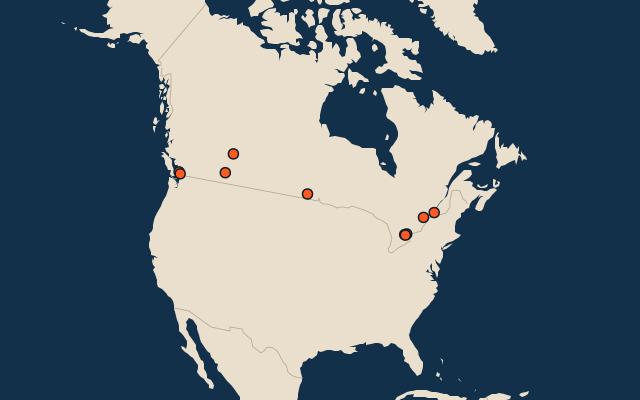
All of North America
More in Canada
- 25 largest cities in Canada
- Provinces and territories of Canada
- 25 largest lakes in Canada
- 25 longest rivers in Canada
- 25 highest peaks in Canada
- 25 largest islands in Canada
- 25 longest fjords in Canada
- Flags of the provinces and territories of Canada
- Cities ranked 26–50 in Canada
- 10 most populous provinces and territories of Canada
In the regions of Canada
- 10 largest cities in Alberta
- 10 largest cities in British Columbia
- 10 largest cities in Manitoba
- 10 largest cities in New Brunswick
- 10 largest cities in Newfoundland and Labrador
- 10 largest cities in Nova Scotia
- 10 largest cities in Ontario
- 10 largest cities in Quebec
Other countries of North America
- 25 largest cities in the United States
- 10 largest cities in the United States
- Cities ranked 26–50 in the United States
- State capitals of the United States
- 25 largest cities in Mexico
- 10 largest cities in Mexico
- Cities ranked 26–50 in Mexico
- State capitals of Mexico
The whole world
How the figures are measured
Cities ranked by the population of each municipality, as Statistics Canada counts it (1 July 2025): census subdivisions (municipalities). Census subdivisions (cities, towns, townships, reserves, unorganized areas) of 5,000 or more; the aggregate rows are dropped. Kind is the census subdivision type code in the office name (C, T, CY, ...). Estimates are preliminary postcensal figures. A city that is not one of Canada’s municipalities is left out.