GeotchaA geography quiz on a real globe
Cities ranked 26–50 in South America
25 cities, each one drawn on a satellite globe. Name it when it lights up, find it when you are given its name, or type every one you can remember in Name all.
Free to start: a few quizzes a day cost nothing, and Geotcha Plus opens every quiz. What you miss comes back for review until it sticks.
The full list
About this quiz
Valencia is the largest of the 25 cities in this quiz, at 2.1 M; Londrina is the smallest listed, at 1.1 M. The three largest hold 17% of the combined population of all 25. They lie in eight countries; Brazil has the most, with nine.
The cities
- 1Valencia Venezuela2.1 M
- 2Santa Cruz de la Sierra Bolivia2 M
- 3La Paz Bolivia1.9 M
- 4Vitória Brazil1.9 M
- 5Córdoba Argentina1.8 M
- 6Montevideo Uruguay1.8 M
- 7Santos Brazil1.8 M
- 8São Luís Brazil1.5 M
- 9Rosario Argentina1.5 M
- 10Maracay Venezuela1.5 M
- 11Bucaramanga Colombia1.4 M
- 12Barquisimeto Venezuela1.4 M
- 13Natal Brazil1.4 M
- 14Cochabamba Bolivia1.3 M
- 15Florianópolis Brazil1.3 M
- 16Cartagena Colombia1.3 M
- 17Arequipa Peru1.2 M
- 18João Pessoa Brazil1.2 M
- 19Maceió Brazil1.2 M
- 20Mendoza Argentina1.2 M
- 21Cúcuta Colombia1.2 M
- 22San Miguel de Tucumán Argentina1.1 M
- 23São José dos Campos Brazil1.1 M
- 24Valparaíso Chile1.1 M
- 25Londrina Brazil1.1 M
On the map
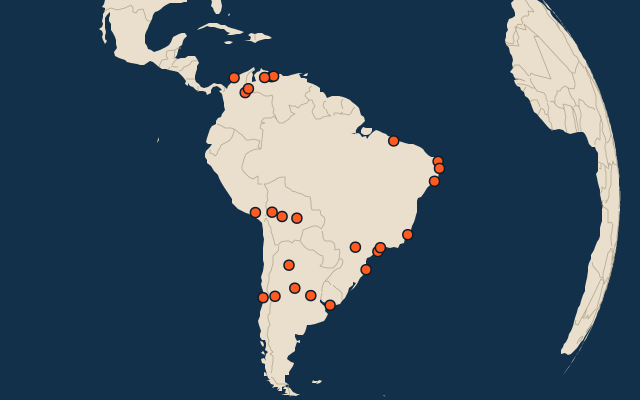
The whole world
More in South America
- 25 largest cities in South America
- Countries of South America
- 25 largest regions in South America
- 25 largest lakes in South America
- 25 longest rivers in South America
- 25 highest peaks in South America
- 25 largest islands in South America
- 9 largest glaciers in South America by area
- Flags of South America
- Capitals of South America
Other continents
- 25 largest cities in Africa
- Cities ranked 26–50 in Africa
- Capitals of Africa
- 25 largest cities in Asia
- Cities ranked 26–50 in Asia
- Capitals of Asia
The whole world
How the figures are measured
Population of the metro area: the city and the places continuously built up around it, as Thomas Brinkhoff’s Major Agglomerations of the World (citypopulation.de) counts them from censuses projected to 1 January 2026, the list most rankings use. It covers every agglomeration of 1 million or more; below that, a city ranks by its urban centre in the United Nations’ World Urbanization Prospects 2025 at 1 January 2026 (every city of 300,000 or more and every capital, counted by the Degree of Urbanisation on a 1 km grid), and a smaller city by its city-proper figure. Each source agglomeration is counted once: its main city and named core cities are accepted answers for the same entry. The included core cities are listed on its card. These agglomerations are not official US metropolitan statistical areas. Cities of the polycentric regions excluded from this source list still rank by their own figures. Ranked 26 to 50: the cities at those places in the ranking by this measure.