GeotchaA geography quiz on a real globe
17 best known World Heritage Sites in South Korea
17 World Heritage Sites, each one drawn on a satellite globe. Name it when it lights up, find it when you are given its name, or type every one you can remember in Name all.
Free to start: a few quizzes a day cost nothing, and Geotcha Plus opens every quiz. What you miss comes back for review until it sticks.
The full list
About this quiz
The quiz covers 17 World Heritage Sites, from Changdeokgung and Jongmyo to Seokguram Grotto and Bulguksa Temple.
What they are known for
- Changdeokgung: A cultural World Heritage Site, inscribed in 1997
- Jongmyo: A cultural World Heritage Site, inscribed in 1995
- Royal Tombs of the Joseon Dynasty: A cultural World Heritage Site, inscribed in 2009
- Hwaseong Fortress: A cultural World Heritage Site, inscribed in 1997
- Namhansanseong: A cultural World Heritage Site, inscribed in 2014
- Gochang: A cultural World Heritage Site, inscribed in 2000
- Baekje Historic Areas: A cultural World Heritage Site, inscribed in 2015
- Gyeongju Historic Areas: A cultural World Heritage Site, inscribed in 2000
The World Heritage Sites
- 1Changdeokgung
- 2Jongmyo
- 3Royal Tombs of the Joseon Dynasty
- 4Hwaseong Fortress
- 5Namhansanseong
- 6Gochang
- 7Baekje Historic Areas
- 8Gyeongju Historic Areas
- 9Jeju Volcanic Island and Lava Tubes
- 10Sansa
- 11Getbol
- 12Gaya Tumuli
- 13Seowon
- 14Petroglyphs along the Bangucheon Stream
- 15Haeinsa Temple Janggyeong Panjeon
- 16Historic Villages of Korea: Hahoe and Yangdong
- 17Seokguram Grotto and Bulguksa Temple
On the map
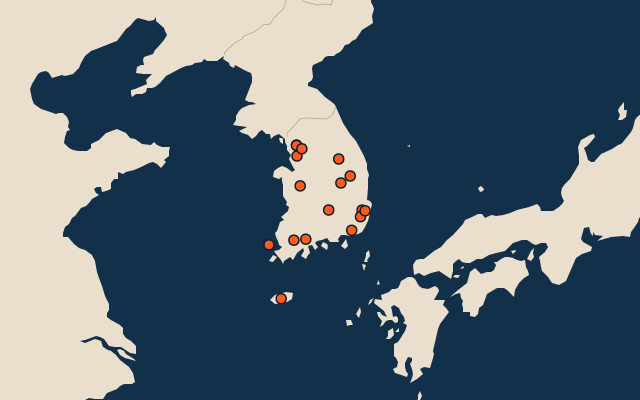
All of Asia
- 22 largest glaciers in Asia by area
- 22 best known canyons and gorges in Asia
- 25 best known World Heritage Sites in Asia
More in South Korea
- 25 largest cities in South Korea
- Provinces of South Korea
- 9 longest rivers in South Korea
- 20 highest peaks in South Korea
- 25 largest islands in South Korea
- Flags of the provinces of South Korea
- 10 largest cities in South Korea
- 10 most populous provinces of South Korea
- Cities ranked 26–50 in South Korea
- Municipalities of South Korea
Other countries of Asia
- 25 best known World Heritage Sites in India
- 9 best known waterfalls in India
- 25 best known World Heritage Sites in China
- 8 best known plains in China
- 25 best known World Heritage Sites in Japan
- 10 best known World Heritage Sites in Indonesia
- 6 best known World Heritage Sites in Pakistan
- 19 best known World Heritage Sites in Turkey
How the figures are measured
How well known each site is: the number of 59 large Wikipedia editions with an article on it or on the famous place it is named for (Wikidata sitelinks). Properties on UNESCO’s World Heritage List as Wikidata records them, delisted ones left out; a property inscribed in parts counts once. Long official names are cut at the first comma or dash (“Historic Centre of Rome”), or named by the famous place inside them (“Machu Picchu” for its Historic Sanctuary); the full name answers too. Cultural, natural or mixed by its selection criteria. A site is a point, Wikidata’s, and its countries are Wikidata’s.