GeotchaA geography quiz on a real globe
25 largest cities in Northern Europe
25 cities, each one drawn on a satellite globe. Name it when it lights up, find it when you are given its name, or type every one you can remember in Name all.
Free to start: a few quizzes a day cost nothing, and Geotcha Plus opens every quiz. What you miss comes back for review until it sticks.
The full list
About this quiz
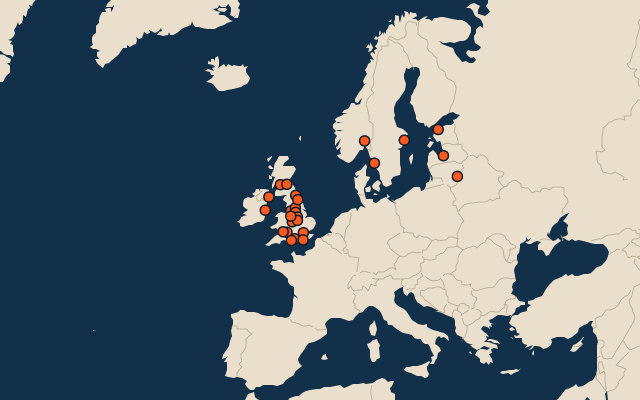
London is the largest of the 25 cities in this quiz, at 15.4 M; Stoke-on-Trent is the smallest listed, at 333 k. London's population is 2.4 times Manchester's (6.4 M). The three largest hold 55% of the combined population of all 25. The United Kingdom has 18 of the 25, in a list that spans seven countries.
What they are known for
- Manchester: Includes Liverpool.
The cities
- 1London United Kingdom15.4 M
- 2Manchester United Kingdom6.4 M
- 3Birmingham United Kingdom4.1 M
- 4Stockholm Sweden2.4 M
- 5Leeds United Kingdom2.3 M
- 6Glasgow United Kingdom1.8 M
- 7Dublin Ireland1.6 M
- 8Newcastle upon Tyne United Kingdom1.5 M
- 9Sheffield United Kingdom1.5 M
- 10Nottingham United Kingdom1.4 M
- 11Oslo Norway1.3 M
- 12Southampton United Kingdom1.2 M
- 13Bristol United Kingdom1 M
- 14Gothenburg Sweden565 k
- 15Riga Latvia549 k
- 16Leicester United Kingdom531 k
- 17Edinburgh United Kingdom522 k
- 18Brighton United Kingdom471 k
- 19Belfast United Kingdom443 k
- 20Tallinn Estonia438 k
- 21Cardiff United Kingdom391 k
- 22Bournemouth United Kingdom388 k
- 23Middlesbrough United Kingdom350 k
- 24Vilnius Lithuania337 k
- 25Stoke-on-Trent United Kingdom333 k
On the map
More in Northern Europe
Similar quizzes
- 25 largest cities in the Amazon basin
- 25 largest cities in the Congo basin
- 25 largest cities in the Mississippi basin
- 25 largest cities in the Ob basin
- 25 largest cities in the Río de la Plata basin
- 25 largest cities in the Nile basin
- 25 largest cities in the Yenisei basin
- 12 largest cities in the Lena basin
The whole world
How the figures are measured
Population of the metro area: the city and the places continuously built up around it, as Thomas Brinkhoff’s Major Agglomerations of the World (citypopulation.de) counts them from censuses projected to 1 January 2026, the list most rankings use. It covers every agglomeration of 1 million or more; below that, a city ranks by its urban centre in the United Nations’ World Urbanization Prospects 2025 at 1 January 2026 (every city of 300,000 or more and every capital, counted by the Degree of Urbanisation on a 1 km grid), and a smaller city by its city-proper figure. Each source agglomeration is counted once: its main city and named core cities are accepted answers for the same entry. The included core cities are listed on its card. These agglomerations are not official US metropolitan statistical areas. Cities of the polycentric regions excluded from this source list still rank by their own figures. Northern Europe: what lies inside the region’s outline, by each item’s point (a lake’s centre, a river’s mouth, a summit).